
There
is evidence that the area has been continuously inhabited
for more than seven thousand years from the middle
new stone age up to the 9th century before the Hungarian
conquest. The most important find is a Roman villa
dating back to the early emperor's époque covering
a basic area of nearly thousand square meters, where
there remains today a garden of ruins. Also from
the Roman époque, from the late emperor's époque is
the "Roman tomb" in the village of Egregy
as well as, not far off the lake of Héviz, beside the
Villa of Margaret, an altar stone dedicated to Jupiter
has been found. On the basis of these discoveries it
can be assumed that the Romans were already aware of
the curative thermal water and this attracted the Roman
villas to this site. In addition the water of the lake
was applied to industrial projects like flax spinning
and leather works. The
name of the lake was mentioned for the first time in
a document in the archives of the cathedral of the
town of Veszprém dated 28th March 1328. In this
document a big marshland named Hosszúsár was mentioned,
which was supplied with hot water from the lake. According
to linguists, the name of Héviz came from the word " hot
spring" and
this name was used also in the Middle Age. During the
Middle Ages there was no record that the water of the
lake of Héviz had been used for curing puposes, but
the possibility cannot be precluded. The thermal
waters hidden in the marshland and reeds were surely
used by the local common people for bathing.
Sources from
the 17th century inform us about water regulation works
in the valley of Héviz in connection with the establishment
of ills, which make reference to the use of the water
running down. By the the end of the 18th century the
bath of Héviz had come into existence. The first scientific
analysis of the water of the lake and its publication
was carried out by Ferenc SZLÁBY, the main doctor of
the district and physician in the county of Zala in
1769. Towards
the end of the century the lake of Héviz was represented
on the individual maps. On the first relief map of
the army of the emperor of Austria, Josephus II in
1783, the lake of Héviz was marked as a lake of warm
water containing sulphur and the stream flowing from
it was indicated under the name "stream of
Héviz. " Later
the name of the stream "warm brooklet" was
used and people commenced to use the name of Héviz
(warm water) exclusively for the lake. The name of
Héviz first appeared in print in 1780 in the work of
WINDISCH Károly Gottlieb of German language (''The
Geography of the Hungarian Kingdom''). Héviz was also
mentioned in the Hungarian geographic encyclopaedia
of KORABINSZKY
János Mátyás, published in 1786. The value of the valley
of Hévíz in the 18th century was principally about
its mills and occasionally the wild ducks were mentioned. During
the 19th century the use of the curative water came
into the limelight. The
building of the medicinal baths was the achievement
of György FESTETICS. The viability of a more
important enlargement was carried out through surveying
in the years of 1857-58, then a decade later, through
the change contract between the bishop of Veszprém
and count Tasziló FESTETICS. As
a consequence of this contract, the proprietor acquired
an area which was suitable for building, where he built
up the so-called "New Settlement". In
1870-1, not far off the lake, seven houses were built.
The so-called "Seven Houses" are still standing.
In 1898, thanks to Sándor LOVASSY, Indian water-lilies
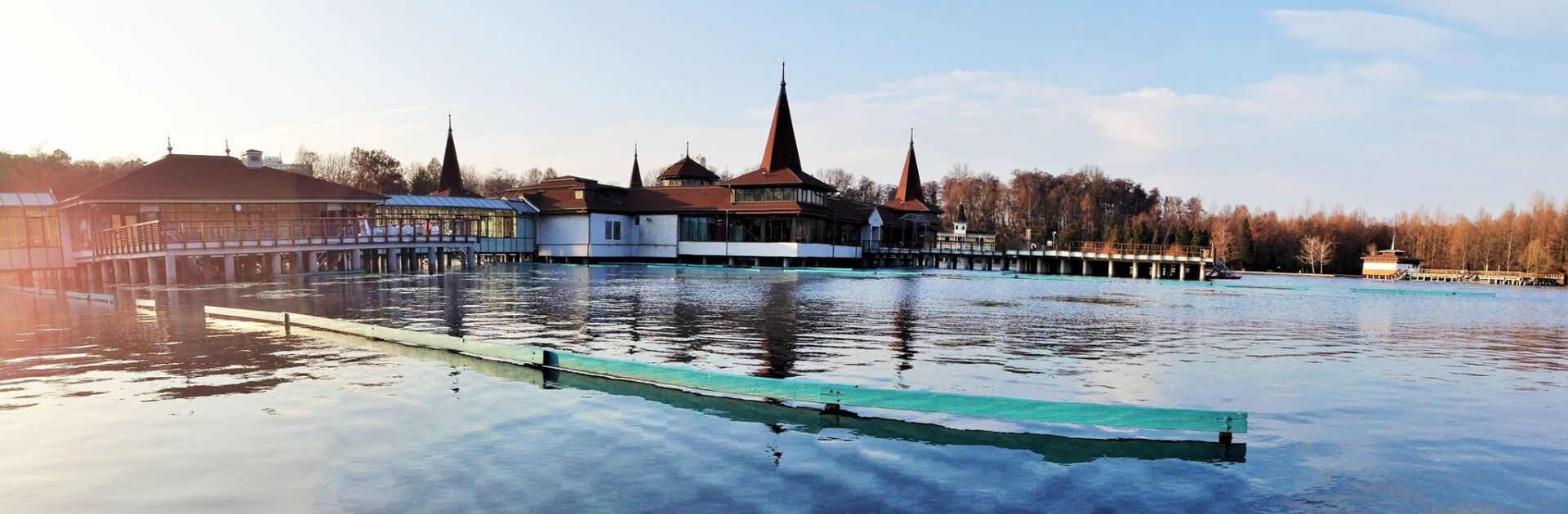
were planted on the lake. The flowers remain a spectacle
of the lake of Héviz. The development of the lake of
Héviz had an important upturn in 1905 when it was rented
by the beer-maker of the town of Keszthely, Vencel
REISCHL, from the proprietor Festetics for 35 years.
The town become a spa known all over Europe in the
years before the First World War. The period of 35
years between the two wars was an important period
of the bath's development. The number of the visitors
rapidly increased, more and more visitors came from
abroad. Hévíz was classed amongst the most popular
of European health resorts. Building
works started, not only beside the lake, but also in the locality. In the
town the catering industry and the renting of rooms became more and more
a way of life in order to gain the daily basic needs. In
the middle of the 20th century the town became the
centre of its area with its services and programs becoming
more and more numerous. Hévíz is today not only one
of the most important health resorts of Hungary, but
also that of Europe, "where the pain dies",
where all guests are warmly welcomed, both the overseas
and the home guests, be healthy or ill, be rich or
less rich in the same way.